
Colne Primet Academy
Design Technology
Year 7
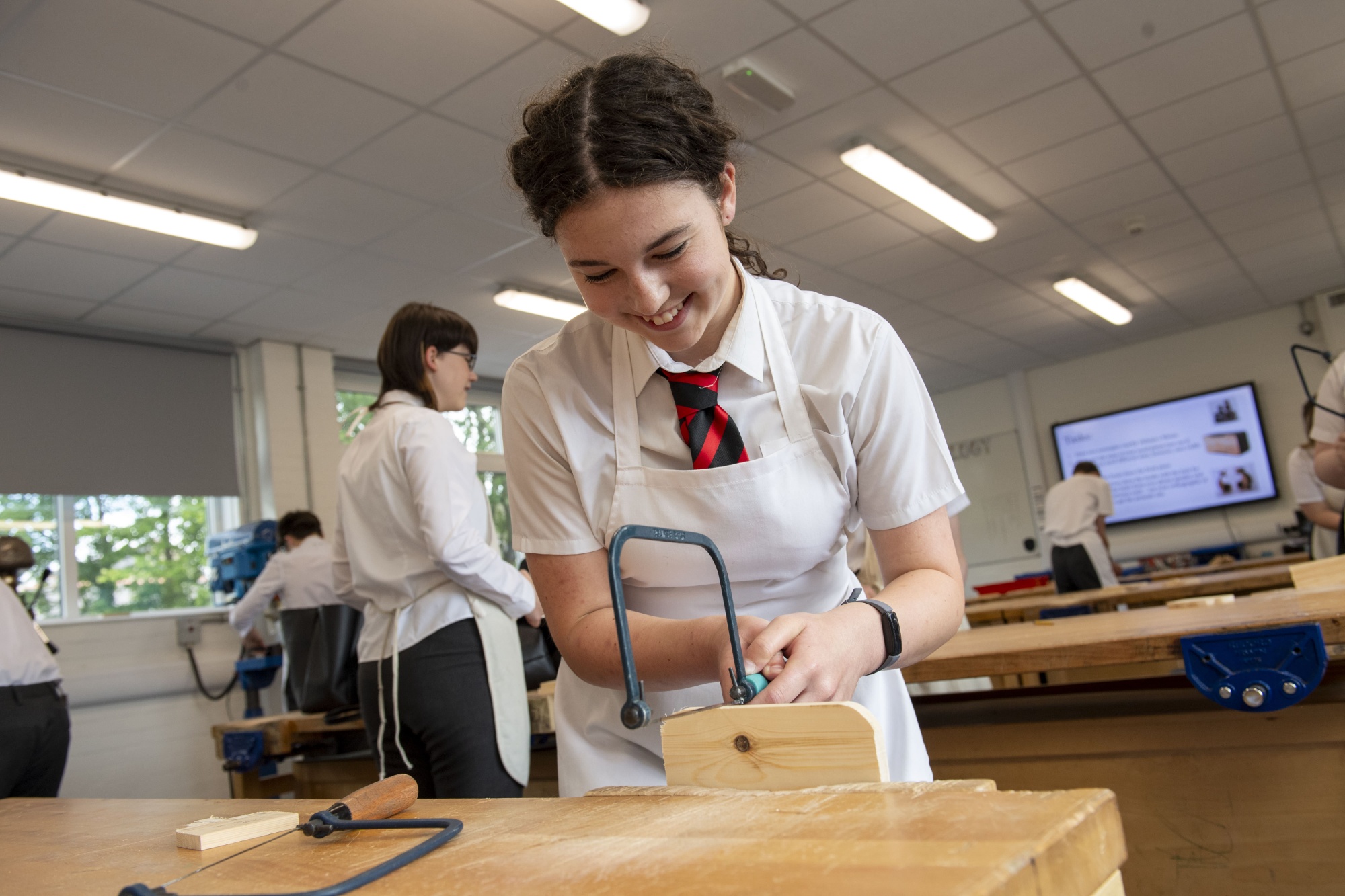
Throughout the year, students develop foundational skills in design and practical manufacturing through a series of creative projects. The curriculum begins with an essential focus on health and safety in the workshop, ensuring students understand hazards, risks, and safe practices when using tools and machinery. Next, learners explore materials and sustainability, gaining knowledge about plastics, their properties, recycling processes, and the environmental impact of plastic pollution. Building on this, students undertake the Acrylic Keyring Project, where they apply design principles to create sea-life-themed keyrings. This includes generating and annotating design ideas, peer evaluation, and refining final designs. In the latter part of the year, emphasis shifts to practical skills, such as using coping saws, creating templates, drilling, and finishing acrylic products to a high standard.
In the Spring & Summer Term, students move into textiles with the Mini Monsters Project, where they design and manufacture a felt soft toy inspired by the doodle art style of Jon Burgerman. The project begins with artist research and the development of a design brief and specification, followed by creating multiple annotated design ideas. Students then learn essential textile skills, including threading needles, tying knots, and mastering stitches such as running, back, and blanket stitch. They create templates, cut felt accurately, and assemble their mini monsters with hand-stitched embellishments. The project emphasizes creativity, precision, and safe use of textile tools, culminating in a finished product and an evaluation of design and making processes.
Year 8
In Year 8 Functional Skills, students develop practical workshop skills through a series of focused lessons. They learn accurate marking out, safe use of hand tools and machinery, and assembly techniques. Emphasis is placed on health & safety, tool selection, and accuracy. Students’ complete skills audits and set improvement targets after each practical activity.
In the Autumn and Spring term students complete a Biomimicry Light Project where they design and make a desk lamp inspired by nature. The project develops skills in research, design thinking, client profiling, CAD, electronics, and practical making. Students learn about sustainability, biomimicry, materials (metals, timbers, manufactured boards), and basic electronics. The project culminates in a functional lamp and an evaluation of the design process.
In the summer term, students will complete a Cam Toy Project that introduces mechanical movement through cams. They will design and make a wooden cam toy that uses a cam mechanism to create vertical motion. Students will develop skills in design sketching, peer evaluation, CAD planning, cutting lists, and workshop safety, culminating in a finished product and evaluation
Year 9
The Spatial Design project introduces students to architectural design principles and modelling techniques. Beginning with a design brief to create a youth centre, students explore themes of innovation, sustainability, and materials, researching architectural styles and developing initial ideas through freehand sketching and annotation. They progress to advanced skills such as one-point and two-point perspective drawing, CAD modelling in Google SketchUp, and physical model making using card and foam board. The project emphasizes creativity, technical accuracy, and safe tool use, culminating in a final CAD model, a physical prototype, and an evaluation of design decisions.
The Functional Skills project focuses on building core technical drawing and presentation skills essential for design work. Students learn and apply two-point perspective, orthographic projection, crating techniques, and isometric drawing, alongside rendering methods to show light and shadow effectively. These activities develop precision and confidence in both freehand and structured drawing, preparing students for more complex design tasks. The project concludes with a series of assessed drawings and self-reflection tasks to reinforce accuracy and improvement.
In the summer term students will undertake a Sustainable Furniture Design project that integrates research, design, CAD modeling, and practical making skills. The focus is on creating a small piece of furniture using sustainable or reclaimed materials, designed for flat-pack assembly and disassembly. Students will learn about sustainability, ergonomics, material properties, and knock-down fittings while developing technical drawing and workshop skills. The project culminates in a finished product and a design portfolio.
Year 10
Bird Box Project & Introduction to GCSE Design & Technology
The Autumn Term begins with an introduction to GCSE Design & Technology, where students learn the importance of design briefs, client profiles, and user-centered design. They explore art and design movements such as Memphis and Arts & Crafts, investigating the work of influential designers to inspire their own ideas. The Bird Box project challenges students to design and manufacture a functional outdoor product that reflects the style of a chosen movement. Key skills developed include isometric and two-point perspective drawing, orthographic projection, and annotation techniques to communicate design intent. Students also create cutting lists, apply CAD for 2D and 3D design, and gain practical experience in the workshop, focusing on measuring, marking out, cutting, assembly, and surface decoration. Sustainability principles and material finishes are embedded throughout the project, which concludes with a plan of manufacture, a completed bird box, and a detailed evaluation of design decisions and modifications.
In the Spring Term, students complete a practice NEA project focused on designing and making an innovative kitchen storage solution. The project begins with a task analysis to identify user needs, problems, and design restrictions, followed by creating a detailed client profile through interviews and research. Students analyze existing products to understand cost, function, and aesthetics, and use this research to develop design possibilities and write a clear design specification. They then generate and annotate three distinct design ideas, incorporating client feedback to refine concepts. Practical modelling and testing are used to evaluate ideas, with improvements documented through sketches and annotations. The project concludes with a final design presentation, a plan of manufacture, and a cutting list, ensuring students demonstrate both creative and technical skills while considering sustainability and user-centered design principles.
In the Summer Term, students complete a mini-Design & Technology skills-building project designed to prepare them for the Non-Examined Assessment (NEA) starting on the 1st of June. Students will focus on building confidence and competence in core workshop skills through a hands-on practical project. This mini project emphasizes accurate measuring, marking, and cutting techniques, alongside safe and effective use of tools and equipment. The learner practices joining methods such as screws, nails, and adhesives, and explores surface finishing techniques including sanding, painting, and varnishing to achieve a professional standard. The project also introduces simple decorative processes and reinforces the importance of tolerance and accuracy in manufacturing. Students produce a small functional product—such as a phone stand or desk organizer—and complete a short evaluation of their process and outcome. This practical experience ensures students are well-prepared for more complex tasks in future coursework.
Year 11
The Year 11 Design & Technology curriculum focuses on completing the Eduqas Non-Exam Assessment (NEA) alongside developing strong theoretical knowledge for the final examination. Across the autumn and spring terms, students engage in the full iterative design process: exploring contextual challenges, conducting research, creating client profiles, and producing detailed design briefs and specifications. They then progress to generating and developing creative ideas, modelling concepts, and selecting appropriate materials and components with sustainability in mind. Technical communication skills are reinforced through CAD, orthographic drawings, and manufacturing plans, culminating in the production of a high-quality prototype. In the summer term, students complete their NEA portfolio and prototype before transitioning to intensive exam preparation, focusing on study skills, revision strategies, and targeted theory review to ensure success in both practical and written assessments.
If you would like any more information about our Design Technology curriculum, please contact Mrs S Goldie, Head of Creative Arts and Technology, by emailing sgoldie@colneprimet.co.uk, filling in the form on our contact us page or phoning the main office to arrange a call back.