
Colne Primet Academy

‘Proud to be PRIMET’
Food Technology
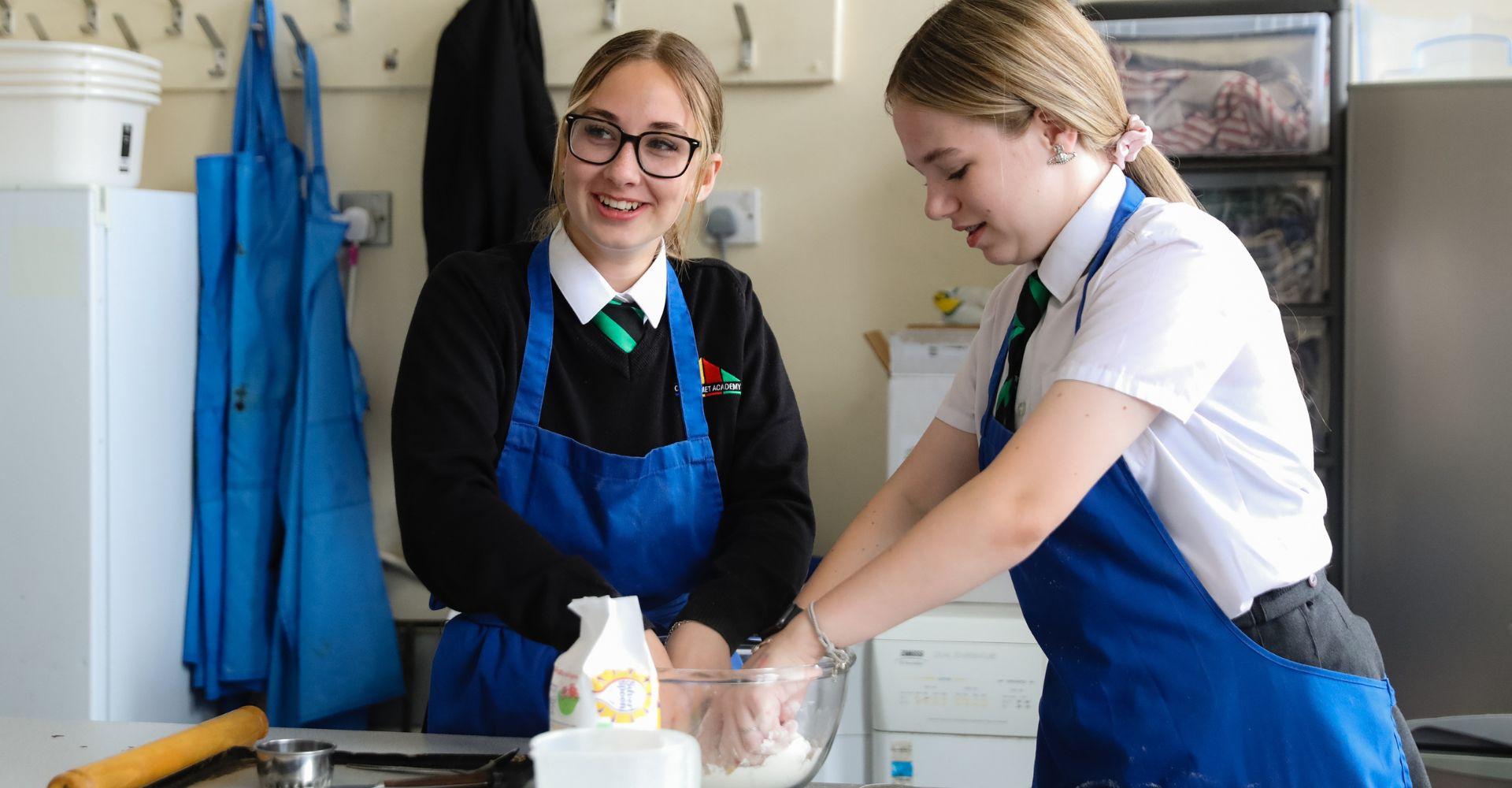
Year 7
The Year 7 Food Technology curriculum introduces students to the basics of food preparation, nutrition, and kitchen safety. A large emphasis is put on Health and Safety in the kitchen, looking in depth at hazards and risks. Students will take part in both practical workshops and written tasks to gain a thorough understanding of what a hazard is, the risk, and how to prevent this.
Students will explore the 4 C’s, with these lessons students will learn vital information regarding Health and Safety in the kitchen. They will develop cleaning skills, through practical exploration of preparing their workspace and cleaning down the area at the end of a practical activity. They will gain an understanding of cross contamination, how it happens, and the results of cross contamination on health. They will start to gain an understanding of cooking food, focusing on temperature, and how to keep food stored, particularly at the chilling process. This will give them a thorough understanding of how to ensure they are safe in the kitchen and will be utilised every term.
In Year 7 we also explore the allergies, intolerances and the legal requirements such as ingredient lists, labelling and sell by dates.
The intent is to build foundational knowledge and skills, encourage creativity, and increase confidence in the kitchen. Giving students a basic understanding in the first term and developing their understanding and skills throughout the following term.
Students will learn about healthy eating, food hygiene, and basic cooking techniques to enable them to produce simple, nutritious meals. Students will have to explore cooking skills such as cutting techniques, using equipment, and following recipes to make meals. They will look at preparation techniques such as boiling, simmering, and baking methods using appropriate recipes to be able to apply the skills too.
Students will develop evaluative skills and be able to reflect on their practice. They will understand the requirements and be able to reflect on the key ssue they have faced. This will help them to solve problems and improve their cooking practice.
Year 8
The Year 8 Food Technology curriculum builds on the foundation skills developed in Year 7, introducing more complex techniques and a deeper understanding of nutrition and food science.
Students will explore cultural and environmental aspects of food, as well as a further look at the functional properties of some ingredients.
The intent is to build intermediate knowledge and skills, advanced techniques, nutritional understanding and sustainability, and increasing confidence in the kitchen.
Students will begin to adapt recipes and consider the wider impact of their food choices.
By the end of Year 8, students will:
-
Demonstrate intermediate cooking skills such as kneading, shaping and more complex sauces and dishes.
-
Understand the nutritional needs of different life stages (teenagers, adults and elderly and how to adapt recipes to cater for those needs.
-
Explore the functional properties of ingredients (gelatinisation and emulsification) and apply this knowledge to practical tasks.
-
Investigate the environmental impact of food choice, including food miles, seasonality and sustainable sourcing
-
Work more independently, planning and preparing dishes with lower levels of direct supervision.
Year 9
The Year 9 Food Technology curriculum is designed to re-engage students with more creative, project-based learning while building on the advanced skills from Year 8. Topics focus on real-world applications, innovation, and independence, with an emphasis on fun, challenge, and relevance to modern food trends.
By the end of Year 9, students will:
-
Investigate advanced cooking techniques (e.g., sous-vide, fermentation, molecular gastronomy).
-
Design and adapt recipes for dietary needs (e.g., vegan, gluten-free) and sustainability.
-
Explore food entrepreneurship, including costing, branding, and marketing dishes.
-
Analyse global food issues, such as food waste, fast food culture, and ethical sourcing.
-
Work independently on extended projects with minimal supervision.
Year 10
The WJEC Eduqas GCSE in Food Preparation and Nutrition equips students with the knowledge, understanding and skills required to cook and apply the principles of food science, nutrition, and healthy eating.
It encourages students to cook, enables them to make informed decisions about food and nutrition and allows them to acquire knowledge to be able to feed themselves and others affordably and nutritiously, now, and later in life.
At the end of KS4, students will be able to demonstrate effective and safe cooking skills by planning, preparing, and cooking a variety of food commodities whilst using different cooking techniques and equipment.
They will develop knowledge and understanding of the functional properties and chemical characteristics of food as well as a sound knowledge of the nutritional content of food and drinks.
Students will understand the relationship between diet, nutrition and health, including the physiological and psychological effects of poor diet and health; as well as understanding the economic, environmental, ethical and socio-cultural influences on food availability, production processes, diet and health choices.
Through practical skills in conjunction with theory lessons, students will demonstrate knowledge and understanding of functional and nutritional properties, sensory qualities and microbiological food safety considerations when preparing, processing, storing, cooking, and serving food.
The students will understand and explore a range of ingredients and processes from different culinary traditions (traditional British and international) to inspire new ideas or modify existing recipes.
Year 11
The qualification is made up of 2 units
Unit 1: The Hospitality and Catering industry
Students will
- Learn about the hospitality and catering industry, the types of hospitality and catering providers and about working in the industry.
- Learn about health and safety, and food safety in hospitality and catering, as well as food related causes of ill health.
Unit 1 enables students to gain and develop comprehensive knowledge and understanding of the hospitality and catering industry including provision, health and safety, and food safety. This is unit is assessed by a written exam and is worth 40% of the student’s overall grade
Unit 2: Hospitality and catering in action
Students will:
- Learn about the importance of nutrition and how cooking methods can impact on nutritional value.
- Learn how to plan nutritious menus as well as factors which affect menu planning.
Students will learn the skills and techniques needed to prepare, cook and present dishes as well as learning how to review their work effectively. They will be given an exam brief from the exam board to use to create their work.
If you would like any more information about our Food Technology curriculum, please contact Mrs S Goldie, Head of Creative Arts & Technology, by emailing sgoldie@colneprimet.co.uk, filling in the form on our contact us page or phoning the main office to arrange a call back.